Last updated November 18, 2026


Free written scope consultation - allowances, timeline, and change-order rules on paper before a single trade is scheduled
Driveway & Pavers Maintenance Schedule: What to Do and When
Joint sand in a North Las Vegas driveway loses roughly 30% of its depth to wind erosion every year. Most homeowners notice only after a paver shifts and a tire drops into the gap. The desert doesn’t follow the seasonal maintenance advice written for temperate climates, so a North Las Vegas paver system needs four specific interventions per year, timed to the Mojave calendar. This guide lays out the month-by-month schedule, the exact product specifications that survive 115°F surface temperatures, the test that tells you when sand needs topping off, and the documented cost of skipping each task.
Quick Answer
In North Las Vegas, a driveway paver system needs joint sand inspection in March, polymeric sand re-topping in April before summer, sealant application in October once surface temperatures drop below 90°F, and an edge restraint and drainage check in December. Each task runs from $0.12 to $0.45 per square foot on schedule; deferring any one of them turns a small maintenance cost into a $8 – $12 per square foot reset of a shifted section.
Styles & brands we work with
- Kitchen remodeling
- Bathroom remodeling
- Home additions & ADU
- Roofing
- Windows & doors
- Driveway & pavers
- Fence
Table of Contents
- Why the Mojave Calendar Beats Generic Maintenance Advice
- The Screwdriver Test: Measuring Joint Sand Depth
- Polymeric Sand Specs That Survive North Las Vegas Heat
- Sealer Selection by Paver Type
- The Month-by-Month North Las Vegas Maintenance Calendar
- The Annual Documentation Checklist
- Cost of Doing It on Schedule vs. Repairing It Later
- Common Mistakes to Avoid
Why the Mojave Calendar Beats Generic Maintenance Advice
Most paver maintenance guides tell you to reseal “before winter” and re-sand “in spring.” That advice was written for climates with freeze-thaw cycles, heavy summer rain, and long stretches of mild weather. North Las Vegas has almost none of those conditions. What North Las Vegas has is wind, sustained surface heat, and an annual monsoon window from July through September that shows up fast and leaves standing water on a driveway that hasn’t been graded correctly.
The failure modes here are different, and the timing has to match:
- Wind erosion of joint sand is the dominant annual loss. North Las Vegas sees spring wind events that scour exposed sand out of joints in days, especially on driveways facing the open desert on the city’s northern edges.
- Thermal expansion is severe. Concrete and clay pavers on a west-facing driveway can hit 150°F surface temperature in July. Joint sand that’s rated for temperate use softens, washes, or cracks in that heat.
- Sealant applied above 90°F flashes off before it penetrates the paver surface. It skins over, cures unevenly, and peels within one season. October is when North Las Vegas surface temperatures fall into the application window and stay there long enough for a proper cure.
- Monsoon runoff finds any edge restraint that’s loosened and undermines the base course. That’s a December inspection item, not a spring one.
Build the whole schedule around those four pressures and the rest of the calendar writes itself. If you’re planning new hardscape on the north side of town, the team at Rowan Construction Group’s Driveway & Pavers in North Las Vegas lays out base depth and restraint specs tuned to the same conditions.
The Screwdriver Test: Measuring Joint Sand Depth
You don’t need a moisture meter or a specialty tool to know whether joint sand needs re-topping. A standard flathead screwdriver and a 10-minute walk of the driveway will tell you.
- Pick six test points. Two near the garage apron, two mid-driveway, two at the street edge. On a North Las Vegas driveway facing west, add a seventh on the afternoon-sun side.
- Push the flathead straight down into a joint until you feel it stop against the compacted sand or the chamfered paver edge.
- Mark the depth on the shaft with your thumb, pull it out, and measure against a ruler.
- Apply the quarter-inch rule: joints less than 1/4 inch deep need re-sanding. Joints at 1/4 inch or deeper are holding. Anything below 1/8 inch is urgent, because a paver edge exposed to that depth will chip on the next tire pass.
- Note the readings. Write the six (or seven) numbers in a log. You’ll compare them year to year to see how fast your specific driveway loses sand.
Do this test in March, before the first serious heat. If the March reading shows more than half the joints below the 1/4-inch threshold, a full re-sand in April is the call. If only a few joints are marginal, spot-fill in March and defer the full re-topping to the following spring. The 1/4-inch rule is the single most useful number in this guide; if you remember nothing else, remember that.
Polymeric Sand Specs That Survive North Las Vegas Heat
Standard polymeric sand is formulated for wet climates and temperate summers. In North Las Vegas, a standard polymer will haze over within one season and start to crack out of the joints within two. You need a product rated for extreme heat, and there are two that hold up in the Mojave: Techniseal HP+ and Alliance Gator Maxx G2.
Both are formulated to cure harder, resist softening at high surface temperatures, and hold joint geometry through the thermal cycling a North Las Vegas driveway sees every summer. What to check on the bag or spec sheet:
- Heat resistance rating. Confirm the product is rated for surface temps above 140°F. Both Techniseal HP+ and Gator Maxx G2 carry that rating.
- Substrate compatibility. Both work with concrete, clay, and travertine pavers. Confirm against your specific paver before ordering.
- Application temperature window. Both want surface temps between 32°F and 90°F during installation. In North Las Vegas, that means an April morning start, not an afternoon one.
- Cure time before traffic. Both require 24-hour cure before foot traffic and 72 hours before vehicle traffic. Plan around that, don’t shortcut it.
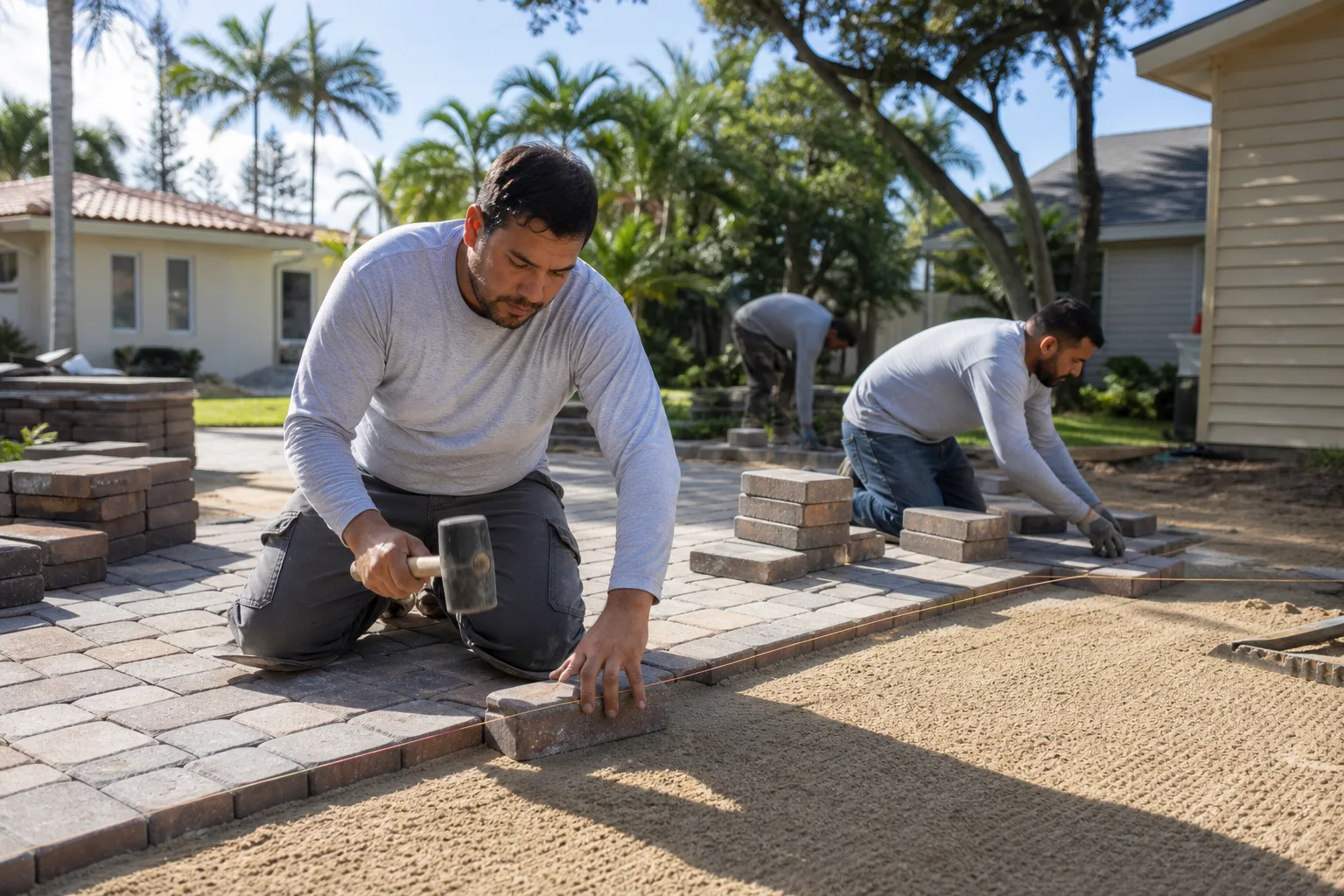
Material cost on polymeric sand runs roughly $0.30 to $0.45 per square foot depending on joint width and product. A 900-square-foot North Las Vegas driveway typically takes 8 to 10 bags of Techniseal HP+ or the equivalent Gator Maxx G2; on schedule that’s a $300 – $400 material bill for the year. Defer the re-sand and you’ll spend five times that resetting a shifted section.
Sealer Selection by Paver Type
This is where most North Las Vegas homeowners get it wrong. Sealers aren’t one product category, and mixing them by paver type causes adhesion failure. The two categories that matter:
- Penetrating silane-siloxane sealers for travertine. These soak into the paver and leave the surface looking natural, with no film. They resist water, salt, and UV without altering the paver color. Material cost is roughly $0.18 – $0.25 per square foot. They need reapplication every three to five years in North Las Vegas conditions.
- Acrylic wet-look sealers for concrete pavers. These form a surface film and give a saturated, wet-stone look that deepens color. Material cost is $0.12 – $0.18 per square foot. They need reapplication every two to three years, more often on high-traffic driveways facing direct afternoon sun.
Mixing the two categories is a real problem: applying a film-forming acrylic over a travertine that already carries a penetrating silane-siloxane build creates a bonding surface the acrylic can’t grip. The film peels in sheets within one season, and removing a failed film layer costs more than the original sealing job. If you’re not certain what’s on the pavers now, test a hidden corner with a small amount of sealer and watch for a reaction over 24 hours before committing to the whole driveway.
Sealant application timing matters as much as the product. In North Las Vegas, apply after surface temperatures drop below 90°F. That’s October. Apply in March and the sealer flashes; apply in April and the first 100°F day arrives before full cure. October gives you the application window and, critically, the last three or four weeks of stable weather before any cool-season rain.
The Month-by-Month North Las Vegas Maintenance Calendar
Here’s the calendar we walk North Las Vegas homeowners through every year. Print it, tape it inside the garage door, and put the March and October items on your phone calendar with a two-week reminder.
- March – Joint sand inspection. Run the screwdriver test on six or seven points. Note the readings. Check the driveway edge restraints for wiggle or visible gaps, especially on the north edge where spring winds hit first.
- April – Polymeric sand re-topping. If the March readings called for it, re-sand with Techniseal HP+ or Alliance Gator Maxx G2 on an April morning with surface temps below 90°F. Twenty-four hour cure before foot traffic, seventy-two hours before vehicles.
- July – Post-monsoon inspection. Walk the driveway after the first big monsoon event. Look for shifted pavers at the street edge, sand loss around any low spot, and standing water. Standing water means the slope needs attention before the next storm; it’s a five-minute look and a very expensive miss.
- October – Sealant application. Surface temps below 90°F, no rain in the forecast for 48 hours. Penetrating silane-siloxane on travertine, acrylic on concrete pavers, never mixed. Note the product name and application date in the log.
- December – Edge restraint and drainage check. Tap along the paver edge with the flathead. Hollow sound or visible movement means the restraint has lifted and needs reset. Clear any debris from the driveway’s low-side drainage path so monsoon water can move.
That’s the entire year in five visits. Four of them are homeowner-doable; the December restraint check, the October sealing, and any restraint reset are the ones we typically get called for. If your driveway also needs fencing replaced because the winter restraint check turned up a post footing failure, Rowan Construction Group’s Fence Installation in North Las Vegas covers the matching hardscape work in one visit.
The Annual Documentation Checklist
Manufacturers like Belgard require proof of maintenance when a warranty claim comes in. If you can’t show that the joint sand was topped off, sealed, and inspected on schedule, the claim gets denied regardless of whether the failure was a defect. The documentation is worth more than the maintenance job itself.
Keep this in a phone album or an envelope in the garage, updated every year:
- Before-and-after photos of the full driveway, taken in the same four spots (garage apron, mid, street edge, north-edge windward corner) every March and every October.
- Joint sand depth measurements from the March screwdriver test, in a small spreadsheet or notebook. Six or seven numbers per year, with the date.
- Product receipts and empty bags from the polymeric sand and sealer applications. Photograph the bag before it goes to the trash; the UPC and product name are what a manufacturer needs.
- Edge restraint inspection notes from the December check, including any tap-test results and photos of any gap.
- Drone or ladder photos of the full driveway after any monsoon event, showing ponding or runoff paths. This is what makes a drainage claim survive a skeptical warranty reviewer.
On a Belgard paver system specifically, the warranty language asks for documented maintenance every year. That record is the difference between a covered repair and an out-of-pocket reset. A background-checked Rowan technician documents the same way on every visit under the Haven Standard, and a printed photo record is included, not sold as an upgrade.
Cost of Doing It on Schedule vs. Repairing It Later
The numbers below are North Las Vegas market prices for the four scheduled interventions, next to the cost of the same system failing in the way it fails when a task is skipped.
- March joint sand inspection: $0 if you do it yourself with a screwdriver; $75 – $125 for a technician visit that includes a photo record.
- April polymeric sand re-topping: $0.40 per square foot installed, or $0.30 – $0.45 per square foot in material if you self-install. A 900-square-foot North Las Vegas driveway lands at roughly $360 installed.
- October sealant application: $0.12 – $0.18 per square foot material for acrylic on concrete pavers; $0.18 – $0.25 per square foot for penetrating silane-siloxane on travertine. Installed on a 900-square-foot driveway: roughly $180 – $320 material, $350 – $600 installed.
- December edge restraint check: $0 doable yourself; $100 – $150 installed with restraint repair if a section has lifted.
- Full reset of a shifted section (the deferral cost): $8 – $12 per square foot. On a 200-square-foot section that’s $1,600 – $2,400.
The math on the year is stark. On-schedule maintenance on a 900-square-foot North Las Vegas driveway runs roughly $700 – $900 a year fully installed, and the skipped-task reset runs $1,600 – $2,400 for one section. The $8 – $12 per square foot reset cost is the number to keep in mind when the March inspection starts to feel optional.
Fill in the exact surface area of your own driveway against these numbers and you have a real budget. If the driveway is part of a broader exterior project on the same lot, the written pricing approach we use across every trade extends to Rowan Construction Group’s Home Additions & ADU in North Las Vegas as well, so the whole plan carries one number instead of six.
Common Mistakes to Avoid
- Re-sanding in March without the March inspection. Two full bags of polymeric sand applied to joints that didn’t need it wastes $60 on sand and doesn’t solve the actual problem, which is usually a loosened edge restraint. Measure first, sand second.
- Sealing in March “before it gets hot.” North Las Vegas surface temps on a west-facing paver driveway can hit 90°F as early as late March. Sealer applied at 92°F skins over, cures unevenly, and peels in one season. October is the application month.
- Using standard polymeric sand instead of heat-rated product. The $8 you save per bag comes back as a joint-sand failure the first summer. Techniseal HP+ or Alliance Gator Maxx G2 are the only two we recommend for North Las Vegas conditions.
- Mixing sealers across paver types. Penetrating silane-siloxane on travertine and acrylic wet-look on concrete are two different systems; applying one over the other causes film failure and a stripping bill.
- Skipping the December edge restraint check. By the time a North Las Vegas homeowner sees a shifted paver in the street-edge row, the restraint has been loose for months and the base sand has been running out under it through monsoon season.
- Not keeping the documentation. Belgard and other manufacturers ask for annual maintenance proof on a warranty claim; missing records is the single most common reason a valid claim gets denied.
- Ignoring monsoon ponding. Standing water after a July storm is the driveway telling you it’s sloping toward the house. The fix is base work, and it gets more expensive every year it’s deferred.
See the difference
 Before
 After
 Before
 After
 Before
 After
When to Call a Professional
Most of the annual schedule is homeowner-doable. A few situations genuinely need a trained crew: any paver that’s shifted more than 1/4 inch relative to its neighbor, any edge restraint that moves under hand pressure, any driveway that ponds for more than 24 hours after a monsoon, and any surface where the previous sealer type isn’t known and a test patch doesn’t resolve the question. A full reset means lifting the pavers, re-compacting the base, and re-setting the restraint and joint sand; without the right plate compactor and base material, a homeowner fix turns into a repeat failure within the season. North Las Vegas paver driveways on the north side of town, where wind erosion is most aggressive, often need the inspection done more than once a year, and that’s the case where a scheduled visit earns its cost.
Rowan Construction Group North Las Vegas offers free estimates in North Las Vegas – call (844) 708-4417. We’ll bring up to 19 years of technician experience, a documented photo record on the visit, and a written price before any work starts.
Frequently Asked Questions
Once a year, in April, after the March inspection confirms joints are below the 1/4-inch threshold. In north-side North Las Vegas neighborhoods where spring wind erosion is heaviest, some driveways need a spot re-sand in March and the full re-topping in April. The March screwdriver test tells you which year you’re in.
You need a polymeric sand rated for surface temps above 140°F. Techniseal HP+ and Alliance Gator Maxx G2 are the two we recommend for North Las Vegas conditions; standard polymeric sand softens and cracks out of the joints within one or two summers. Both products require surface temperatures between 32°F and 90°F at application, which points you at an April morning.
Penetrating sealers soak into the paver with no surface film; acrylic sealers form a film on top. It matters for travertine because a penetrating silane-siloxane is the correct system for it, and applying acrylic over a previous penetrating coat causes film adhesion failure. Material cost runs about $0.18 – $0.25 per square foot for penetrating, $0.12 – $0.18 per square foot for acrylic on concrete pavers.
No. Rowan Construction Group quotes every paver project – inspection, re-sand, sealing, or full reset – at a flat written price with a written scope, and no change proceeds without a signed change order. That’s Clause 1 of the Haven Standard and it applies across all seven residential trades.
Yes. Belgard and most major manufacturers require documented annual maintenance before they’ll honor a defect claim. A photo record of each year’s inspection, re-sand, and seal job is the evidence you’ll be asked for, and it’s the difference between a covered repair and an out-of-pocket reset.
A 900-square-foot driveway takes one morning to re-sand and one full morning to seal, plus a 72-hour traffic cure after each. Done in April and October as scheduled, the two jobs fit into the year without disrupting daily use, and the total installed cost lands at roughly $700 – $900 for the year. Call (844) 708-4417 for a free estimate on your specific driveway.
The Bottom Line
A North Las Vegas paver driveway is a system on a desert clock: inspect in March, re-sand in April before the heat, re-seal in October once surface temps drop below 90°F, and check the edge restraint in December. The four visits cost roughly $700 – $900 a year on a 900-square-foot driveway, fully installed, and protect against a $1,600 – $2,400 reset of a single 200-square-foot section. Keep the photo record and product receipts; Belgard and other manufacturers want them on a warranty claim. Skip the schedule and the desert will reprice the driveway for you, at $8 – $12 per square foot.
Wherever the driveway sits within a broader exterior plan, start from the Rowan Construction Group North Las Vegas home page, and call (844) 708-4417 for a free estimate on any of the four tasks above. Written price before work starts, documented photo record when the crew leaves, and the 365-Day Done Right Promise printed on the estimate page – not in an asterisk.
Written by the team at Rowan Construction Group North Las Vegas.