Last updated November 18, 2026

Free written scope consultation - allowances, timeline, and change-order rules on paper before a single trade is scheduled
Driveway & Pavers Maintenance Checklist for North Las Vegas Homeowners
A paver driveway that looks flawless in October can be rocking, weedy, and chalky-white by April. The material didn’t fail. The polymeric sand in the joints did. In the Las Vegas Valley, joint sand degrades at roughly twice the rate the manufacturer’s temperate-climate rating assumes, because we run UV indexes above 10 for nearly half the year and then hand the surface a monsoon. This checklist gives North Las Vegas homeowners the exact inspection sequence, the brand-level product specs, and the seasonal calendar to stay ahead of that damage cycle instead of paying to reset it.
Quick Answer
In North Las Vegas, driveway pavers need a full joint-sand inspection every spring, re-sanding every 2 to 3 years instead of the national 4 to 5, a penetrating sealer reapplied every 2 to 3 years, and an efflorescence check after every monsoon season. Skipping a single season here doesn’t cost you a cleaning – it costs $4 to $9 per square foot to reset base and relay pavers.
Styles & brands we work with
- Kitchen remodeling
- Bathroom remodeling
- Home additions & ADU
- Roofing
- Windows & doors
- Driveway & pavers
- Fence
Table of Contents
- Why North Las Vegas Is Harder on Pavers Than Almost Anywhere Else
- The North Las Vegas Paver Maintenance Calendar
- Polymeric Sand: Brand Specs and the 2-to-3-Year Rule
- Efflorescence: The White Bloom and the Two-Step Acid Wash
- Base Compaction Failure: What You Can Fix and What You Can’t
- Sealer Types, Products, and Per-Square-Foot Costs
- If You Have a Concrete Driveway Instead
- Common Mistakes to Avoid
Why North Las Vegas Is Harder on Pavers Than Almost Anywhere Else
Two forces do most of the damage to a paver driveway in North Las Vegas: sustained ultraviolet radiation and caliche. They act on different parts of the system, and understanding both is what separates a driveway that lasts 25 years from one that needs relays at year eight.
UV attacks the binder. Polymeric sand is a mix of graded aggregate and a polymer that cures into a semi-flexible joint. Sun doesn’t just dry it – it breaks the polymer chains down, and once the joint loses flexibility it starts to crack, wash out, and let seed in. Manufacturers rate their sand for a broad national climate band, but the North Las Vegas valley floor sees 290-plus days of sun and summer highs that regularly cross 110°F. A joint that stays intact for five years in Ohio is doing well to reach three here.
Caliche is the second force. This is the calcium-carbonate hardpan layer common across the valley, and it does two things to a driveway. First, it sheds water instead of absorbing it, so a rare rain event runs off fast and finds the lowest edge of your base rather than soaking in evenly. Second, when caliche does take on moisture and then dries, it swells and shrinks – and that movement telegraphs straight up through the bedding layer. That’s why North Las Vegas driveways show settlement at the apron and along the garage slab first, not in the middle of the field.
What we look for on a North Las Vegas inspection, in order:
- Joint depth – is sand sitting within 1/8 inch of the chamfer, or has it dropped below the bevel?
- Rocking pavers at the driveway apron and the garage threshold, where caliche movement concentrates
- White mineral bloom, usually strongest on the shaded north side and after September rains
- Edge creep – pavers sliding outward past the restraint, a sign the edge restraint has loosened
- Low spots that hold a puddle for more than an hour after a storm
If you’re weighing pavers against a poured slab for a replacement, our Driveway & Pavers in North Las Vegas page breaks down materials and costs line by line.
The North Las Vegas Paver Maintenance Calendar
National paver guides tell you to “inspect annually.” That advice misses the fact that the valley has four distinct maintenance windows, and each one catches a different failure. Here’s the calendar we work to.
March: Pre-Heat-Season Inspection
This is the most important visit of the year, because it’s your last chance to fix joints and base before the heat locks everything in place. Sweep the whole surface, probe every joint with a screwdriver tip to check sand firmness, and top off any joint that’s dropped below the chamfer. Check the edge restraint and re-tighten or re-drive any loose spikes. Clean out the expansion joints where the driveway meets the garage slab and the sidewalk – debris packed into those gaps pushes pavers apart over the summer.
June through August: Peak-Heat Watch
Don’t seal in peak heat. Sealant applied above roughly 90°F surface temperature flashes off before it penetrates, and it can leave a haze you’ll be paying to strip. During these months, do spot checks only: look for new joint cracks, keep weeds pulled before they establish, and water the surface briefly in the early morning during extreme heat spells to slow polymer degradation. No heavy equipment parked on the same spot for weeks – a trailer tongue or a boat jack sitting on hot pavers will create a depression that doesn’t recover.
September: Post-Monsoon Assessment
Monsoon season is when hidden base problems announce themselves. After the first real rain, walk the driveway and mark every low spot with chalk. Anywhere water stands more than an hour is telling you the bedding layer has shifted. This is also when efflorescence peaks – the moisture pulls calcium salts to the surface, and you’ll see the white bloom within days. Photograph it. That record matters if you ever file a workmanship claim or want a second opinion on a repair quote.
December: Winter Inspection and Sealer Planning
Winter is sealer season in North Las Vegas – surface temps sit in the ideal window and cure times are reliable. This is also the time to plan any re-sanding. Check the whole driveway one more time, note every cracked joint and settlement spot, and schedule the work before spring.
Polymeric Sand: Brand Specs and the 2-to-3-Year Rule
Polymeric sand is the single highest-return maintenance item on a North Las Vegas paver driveway, and it’s the one most homeowners defer too long. The national recommendation is to re-sand every 4 to 5 years. In North Las Vegas, plan on 2 to 3 – and if your driveway takes full afternoon sun with no shade, lean toward the shorter end.
Two products we specify and trust for this climate:
- Alliance Gator – their Gator Maxx and Super Sand lines are formulated for high-heat applications and cure to a firmer joint than standard polymeric. Good choice for full-sun driveways.
- Techniseal – their HP NextGel is a strong option for a driveway that sees vehicle traffic, since the gel formulation resists washout better in the first rain after application.
Whichever product you use, the installation steps matter as much as the brand:
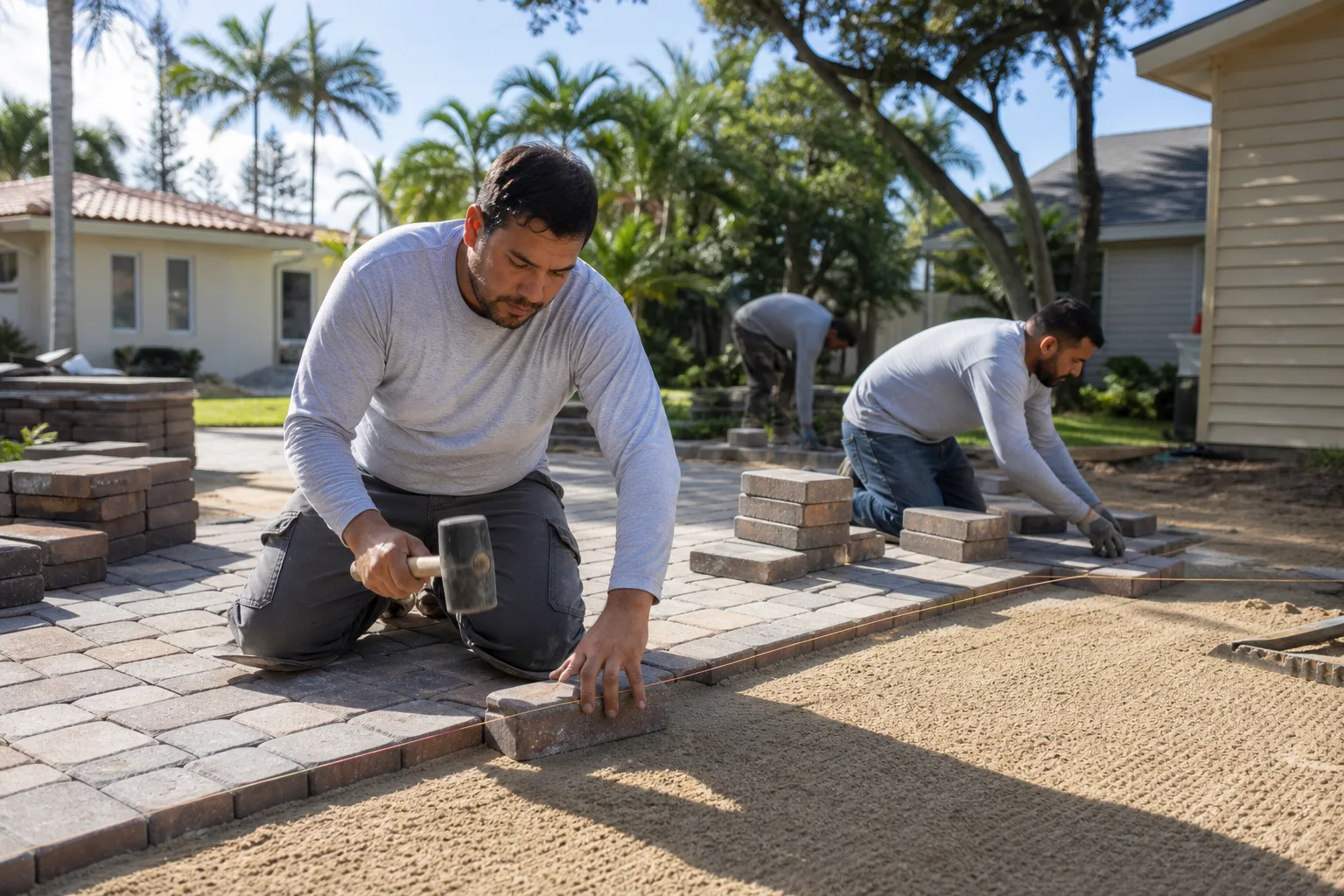
- Remove failed sand to a depth of about 1 inch using a screwdriver, joint knife, or a pressure washer on low with a fan tip held at 45 degrees.
- Clean the joints completely – compressed air or a leaf blower – and let the surface dry fully.
- Fill joints with dry polymeric sand, sweeping it in at a 45-degree angle across the joint, never straight along it.
- Compact the sand with a plate compactor fitted with a rubber pad, working in overlapping passes.
- Activate the polymer with a fine mist – two light passes, letting the water soak in between, never a flood that washes the sand out.
- Let it cure for 24 hours with no foot traffic and 48 hours before vehicles.
If you’re hiring this out, a re-sand on a typical two-car North Las Vegas driveway runs roughly $1.50 to $3.00 per square foot in materials and labor. Doing it yourself on a 500-square-foot driveway saves money but takes a full weekend and a rented compactor.
Efflorescence: The White Bloom and the Two-Step Acid Wash
Efflorescence is the chalky white mineral deposit that appears on desert pavers, and it’s the question we get most from North Las Vegas homeowners. Here’s what’s actually happening: moisture moves through the paver, dissolves calcium salts from the concrete or the caliche below, and carries them to the surface. When the water evaporates, the salts stay behind as a white bloom. It’s a moisture problem expressing itself on the surface, not a stain.
Before you treat it, test whether it’s superficial or structural:
- The water test: pour a cup of water on the bloom. If it disappears or fades, it’s superficial efflorescence – cosmetic, treatable.
- The crumble test: press a fingernail into the white area. If the paver surface flakes or powders, that’s subflorescence or spalling, a sign of internal moisture damage that needs a contractor’s look, not a wash.
For superficial efflorescence, the two-step acid-wash protocol:
- Dry-brush the surface to remove loose bloom, then wet the pavers thoroughly with clean water – you’re pre-soaking so the acid doesn’t burn into dry concrete.
- Apply a diluted muriatic acid solution (typically 1 part acid to 10 parts water, always acid into water, never the reverse) with a plastic watering can or sprayer, working in small sections.
- Let it dwell for 2 to 3 minutes, scrub with a stiff-bristle brush, and rinse thoroughly with clean water.
- Neutralize any remaining acid with a baking soda solution and rinse again.
Acid washing is a chemical process and it will etch pavers if you get the dilution or dwell time wrong. If you’ve never done it, or if the bloom keeps returning, that’s a job for a trained crew. Skipping the pre-soak step is the most common mistake – it drives acid into the paver and causes a permanent dull spot.
Base Compaction Failure: What You Can Fix and What You Can’t
Many driveway problems North Las Vegas homeowners call about are actually base problems showing up at the surface. The base is the compacted aggregate layer under the pavers; the bedding layer is the thin sand layer that the pavers sit on. When either fails, the surface tells you.
Signs of base failure:
- Pavers that rock or wobble underfoot – if more than a few rock, the bedding layer has shifted and the base may be compromised.
- Low spots that pool water after rain, especially at the apron or the garage threshold.
- Edge creep – the outer row of pavers sliding away from the field, often because the edge restraint has loosened or the base under the restraint has eroded.
- Step-downs of an inch or more between pavers, which indicate settling, not just joint issues.
What you can self-correct: isolated rocking pavers (two or three, not a field), a loosened edge restraint you can re-tighten, joint sand that has settled, and a low spot caused by an obstruction like a tree root pushing a single paver up.
What requires a contractor: any settlement covering more than a few square feet, any low spot where water pools more than 24 hours after a storm, and any edge creep that recurs after you’ve tightened the restraint. Correcting base failure means lifting the pavers, re-compacting or replacing the base, re-setting the bedding layer, and re-laying – which is a crew job, not a homeowner one. A resetting repair in North Las Vegas typically runs $4 to $9 per square foot depending on the scope.
Sealer Types, Products, and Per-Square-Foot Costs
Sealer is the most misunderstood item on the checklist. Done right, it slows UV degradation, resists stain, and locks joints. Done wrong, it traps moisture, causes haze, and peels. The key distinction is penetrating versus film-forming.
Penetrating sealers soak into the paver and cure below the surface, leaving a natural look with no visible film. They don’t peel because there’s nothing on top to peel. For North Las Vegas’s UV load, penetrating is the default recommendation.
Film-forming sealers sit on top of the paver and can give a wet or glossy look. They offer more stain resistance but are more prone to yellowing, hazing, and peeling under sustained heat, and they need stripping and reapplication rather than a simple top-up. If you want the look, use a product specifically rated for high UV, applied on a cloudy day with surface temps below 90°F.
Products worth naming, since the category is flooded with vague “premium” claims:
- Techniseal – their UV-rated penetrating sealers are formulated for high-sun climates and reapplied every 2 to 3 years.
- Alliance Gator – their sealers pair well with their polymeric sands if you’re redoing both at once.
- Foundation Armor – their penetrating line is widely specified for desert climates and holds up against UV better than most film-forming products.
Cost ranges per square foot in North Las Vegas:
- DIY penetrating sealer: $0.15 to $0.35 per square foot in material, plus a rented sprayer.
- Professional penetrating application: $0.50 to $0.90 per square foot, materials and labor.
- Professional film-forming application: $0.80 to $1.50 per square foot, higher because of the prep and the risk of haze.
That’s a number you can screenshot and compare against any quote you receive. We write it that way on purpose.
If You Have a Concrete Driveway Instead
Much of the older housing stock in North Las Vegas – especially in the neighborhoods built through the 1990s and early 2000s – has poured concrete driveways, and those fail differently than pavers. The maintenance calendar shifts accordingly.
The primary threats to a North Las Vegas concrete driveway are thermal cracking and caliche settlement at the joints. Concrete expands and shrinks with the daily temperature swing, and in the valley that swing can run 30 to 40 degrees. Control joints relieve the stress, but only until they crack and the crack takes on water.
Concrete checklist:
- Fill any crack wider than a credit card with a flexible polyurethane crack filler before the next rain. Rigid fillers fail in our temperature swings.
- Seal the surface every 2 to 3 years with a concrete sealer – it slows UV damage and stops deicing salt you might use in a rare cold snap from eating the surface (yes, a few North Las Vegas winters get cold enough to matter).
- Check for settlement at the apron and the garage threshold, where caliche movement concentrates. Any slab section that has dropped more than 1/2 inch needs a look – mudjacking or foam lifting may be the fix, and a full replacement may be the better answer if the slab is also cracked through.
- Re-caulk the joint where the driveway meets the garage floor every few years. That joint is a water entry point, and water under the slab causes the settlement you can’t see until it’s expensive.
If you’re considering replacing concrete with pavers or the other way around, the honest conversation is about total cost over 25 years rather than first cost. Pavers generally run higher on day one and lower on repairs; concrete runs lower on day one and higher on maintenance.
Common Mistakes to Avoid
- Sealing in summer. Applying sealer when surface temperatures are above 90°F is the most common way North Las Vegas homeowners end up with a hazy, peeling finish they pay to strip. Seal in the cooler months, on a cloudy day.
- Re-sanding on the national 4-to-5-year schedule. That schedule assumes a temperate climate. In the valley, plan on 2 to 3 years, and check the joints every spring so you’re not surprised.
- Skipping the pre-soak before an acid wash. Acid applied to dry pavers etches and dulls them permanently. Pre-soak thoroughly, then treat small sections at a time.
- Ignoring one rocking paver. One loose paver is a one-hour fix; by the time three or four are rocking, the base under them has lost compaction and you’re into a reset.
- Piling sand in a joint that’s fallen below the chamfer. Sand in a joint sitting lower than 1/8 inch below the chamfer is going to wash out before it cures. Remove the old sand to the right depth first.
- Parking a heavy vehicle on the same spot for weeks in summer. A boat trailer or a truck that sits without moving on hot pavers will press a depression the surface never recovers from.
- Believing a “permanent” sealer claim. No sealer on a North Las Vegas driveway is permanent. Any product that claims otherwise is overselling, and you’ll be replacing it in 2 to 3 years regardless.
See the difference
 Before
 After
 Before
 After
 Before
 After
When to Call a Professional
Call a licensed contractor when you see any of the following: settlement covering more than a few square feet; a low spot where water pools more than 24 hours after a storm; edge creep that returns after you’ve tightened the restraint; efflorescence that keeps coming back after a proper acid wash; or any paver surface that flakes or crumbles under a fingernail. Those are base or moisture problems, and no amount of surface maintenance will fix them.
If you’re also thinking about fencing the side yard or adding a detached structure, that work interacts with the driveway – a gate post set into a settling base will lean, and a new slab needs to meet the existing one correctly. Rowan Construction Group North Las Vegas offers free estimates in North Las Vegas for every one of these jobs, including a free second opinion on any written estimate you already have. Call (844) 708-4417, and we’ll bring the numbers in writing before anyone picks up a tool. If your project touches the perimeter, our Fence Installation in North Las Vegas page covers how the two systems meet, and for larger plans, Home Additions & ADU in North Las Vegas explains how a new structure sits next to an existing driveway.
Frequently Asked Questions
Every 2 to 3 years, versus the national recommendation of 4 to 5. The valley’s UV load breaks down the polymer in joint sand roughly twice as fast as a temperate climate does, so the schedule compresses accordingly. If your driveway is in full sun with no shade, lean toward the shorter end and check joint depth every March. Call (844) 708-4417 for a free estimate on re-sanding – we quote a flat price before any work starts.
It’s efflorescence, a mineral deposit left behind when moisture carries calcium salts to the surface. It’s usually cosmetic, and the water test (a cup of water poured on the bloom fades it) confirms superficial efflorescence. If the paver surface flakes or powders under a fingernail, that’s subflorescence and a contractor should look at it. For superficial cases, a proper two-step acid wash clears it – and everything you need to know is in the acid-wash section above.
You can seal it yourself for $0.15 to $0.35 per square foot in material, plus a rented sprayer. Hiring a professional runs $0.50 to $1.50 per square foot for materials and labor, and the main thing you’re buying is correct timing and prep – most DIY sealing failures come from applying in heat or on a poorly cleaned surface. Either way, seal in the cooler months when surface temperatures are below 90°F.
Rocking pavers mean the bedding sand layer under them has shifted, usually because of moisture movement or caliche settlement. One or two isolated rocking pavers can sometimes be reset by a homeowner – lift, re-bed, re-sand. A field of them means the base itself needs re-compaction, which is a crew job. A resetting repair in North Las Vegas runs $4 to $9 per square foot, so catching it early matters.
Most routine maintenance – re-sanding, sealing, replacing a paver or two, crack filling concrete – does not require a permit. A full driveway replacement or a change in the driveway’s footprint that impacts drainage or the right-of-way typically does. The safe approach: ask before you start. Any licensed contractor will tell you exactly which permits a job needs, and pull them. Under Clause 1 of the Haven Standard, the price is written before anyone starts, including permit costs.
A full annual maintenance visit – inspection, joint top-off, weed removal – typically runs $200 to $500 for a two-car driveway. A full re-sand is $1.50 to $3.00 per square foot. A professional sealant application is $0.50 to $1.50 per square foot. A resetting repair is $4 to $9 per square foot. Call (844) 708-4417 for an exact quote – estimates are free, and every quote includes a documented photo record of what we found.
The Bottom Line
The North Las Vegas climate doesn’t give a driveway the same grace period as a temperate one. UV index readings above 10 for roughly six months shorten joint-sand life from five years to two or three, and the caliche under the base turns a small settlement into a full reset if you skip a season. The fix is a calendar: inspect in March before the heat, leave the surface alone in summer, assess after the monsoon in September, and seal in December. Do that, and a paver driveway in North Las Vegas can last 25 years with routine maintenance rather than costly relays. Skip it, and the repair runs $4 to $9 per square foot.
Rowan Construction Group North Las Vegas works across seven residential trades, and we’ve watched enough driveway failures to know which ones were preventable. Every visit includes a documented photo record, every quote is a flat written price before work starts, and our technicians have up to 19 years of experience with the materials this climate throws at them. Start with the Rowan Construction Group North Las Vegas home page to see the full picture, or call (844) 708-4417 to schedule your free estimate.
Written by the team at Rowan Construction Group North Las Vegas.